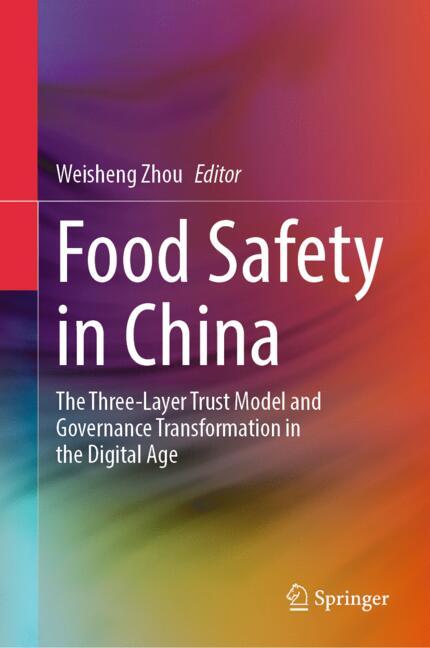
Food Safety in China
Springer Nature Singapore·EAN 9789819237418
Qabbel 1 prezz
| Ħanut | Disponibbiltà | Konsenja | Prezz | Action |
|---|---|---|---|---|
 Springer Nature link.springer.com L-aħjar prezz Fl-istokk | Fl-istokk | B'xejn | €139.09 | Mur → Mur fil-ħanut → |
Storja tal-prezz — l-inqas prezz
L-inqas prezz ta' kuljum fil-ħwienet kollha · medja għal dan il-perjodu: €139.09
As the ancient Chinese saying “Food is the foundation of life and society” (Min yi shi wei tian), recorded in the Book of Han nearly two thousand years ago, suggests, food is not only essential for human survival but also the fundamental foundation of social stability and continuity. Since the Reform and Opening-up period, China, with a population of more than 1.4 billion, has faced the dual challenges of food security (quantitative security) and food safety (qualitative security). In particular, food safety has become one of the most significant public concerns amid rapid economic growth and urbanization. Food scandals, most notably the 2008 melamine-contaminated milk incident, have generated widespread public anxiety about health risks and have also undermined trust in government institutions and business enterprises. Furthermore, with the rapid development of the digital economy, food safety risks have evolved from isolated incidents into structural risks embedded in increasingly complex supply chains and online food delivery (OFD) systems. Consumers can no longer directly observe food production and processing processes, and food safety is increasingly socially constructed through institutions, information systems, and digital platforms. As a result, even when objective safety conditions improve, public anxiety and distrust may persist. This book argues that food safety should be understood not merely as a problem of risk management, but as a challenge of trust construction. To address this issue, it develops a Three-Layer Trust Model consisting of psychological trust (individual level), institutional trust (governance level), and structural trust (societal level), providing an integrated framework for analyzing food safety in contemporary China. The book further conceptualizes food safety as an institutional public good produced through the interaction of institutions, markets, technology, and society, and emphasizes the importance of collaborative governance involving government, enterprises, digital platforms, and consumers. Through an in-depth analysis of China’s experience, this book offers policy implications for rebuilding trust and provides a new analytical framework for public policy design in an era characterized by growing uncertainty and digital transformation.
Comparano iqabbel il-prezzijiet għal Food Safety in China fi 1 ħanut online. L-aħjar prezz llum huwa €139.09. Matul l-aħħar 90 jum, l-inqas prezz ta' kuljum kien medja ta' €139.09. Il-prezzijiet jiġu aġġornati diversi drabi kuljum; il-prezz finali jiġi kkonfermat fil-ħanut.
Aktar minn Springer Nature Singapore

Electronic States in Crystals of Finite Size
Springer Nature Singapore · Kotba
minn €74.89
Ara l-offerta

Progress in Nanoscale Characterization and Manipulation
Springer Nature Singapore · Kotba
minn €171.19
Ara l-offerta

Parity-time Symmetry and Its Applications
Springer Nature Singapore · Kotba
minn €235.39
Ara l-offerta

Quantum Critical Phenomena of Valence Transition
Springer Nature Singapore · Kotba
minn €106.99
Ara l-offerta