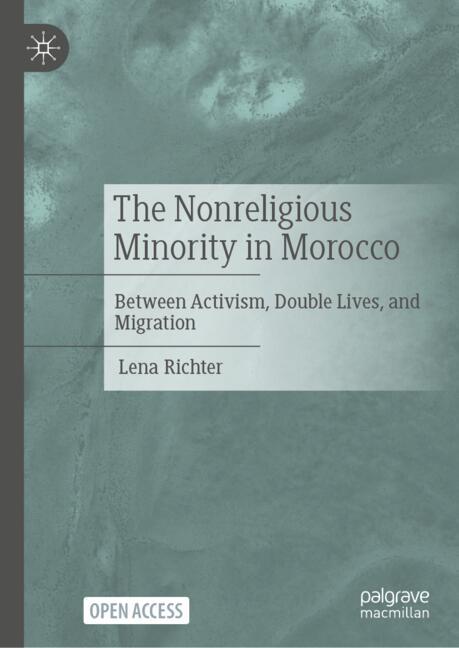
The Nonreligious Minority in Morocco
Springer Nature Switzerland·EAN 9783032349491
Qabbel 1 prezz
| Ħanut | Disponibbiltà | Konsenja | Prezz | Action |
|---|---|---|---|---|
 Springer Nature link.springer.com L-aħjar prezz Fl-istokk | Fl-istokk | B'xejn | €32.09 | Mur → Mur fil-ħanut → |
Storja tal-prezz — l-inqas prezz
L-inqas prezz ta' kuljum fil-ħwienet kollha · medja għal dan il-perjodu: €32.09
This open access volume poses the question of what it means to be nonreligious in a society where religion significantly shapes public institutions, legal frameworks, and societal norms. What expectations, dilemmas, and constraints emerge? And how do those who fall outside the religious mainstream adapt to these challenges? Answering these questions, this long-term ethnographic study illuminates the complexities of being part of a nonreligious minority in contemporary Morocco. Grounded in over a hundred life-story interviews with young adults who self-identify as atheist, agnostic, or cultural Muslim, it weaves together personal trajectories with theoretical insights from minority studies, queer theory, and feminist scholarship. While this case study focuses on Morocco, its findings form part of a broader global discussion on nonreligion. Since the 2010s, nonreligious views have experienced a surge across many Muslim-majority countries, particularly among the tech-savvy urban youth. Nevertheless, distancing oneself from Islam remains contested and carries societal, professional, and institutional repercussions. Against this backdrop, the book follows the diverse ways nonreligious Moroccans try to navigate their predominantly Muslim environment. It explores the promises and limitations of nonreligious activism, the importance of compromises and maintaining relationships with religious family and friends, as well as building connections with other nonreligious individuals, the implications of leading a ‘double life’, and the motives behind moving abroad. By examining these responses from an intersectional perspective, the book offers insights into common minority responses, such as activism, adaptation, concealment, allyship, and migration. This makes it an important read for anthropologists, sociologists, human geographers, and feminist and postcolonial scholars who explore similar themes. At the same time, this work will be of particular relevance to students, researchers, and policymakers with a regional interest in Muslim-majority contexts, such as Morocco and anyone interested in questions of (non)religion and minority dynamics.
Comparano iqabbel il-prezzijiet għal The Nonreligious Minority in Morocco fi 1 ħanut online. L-aħjar prezz llum huwa €32.09. Matul l-aħħar 90 jum, l-inqas prezz ta' kuljum kien medja ta' €32.09. Il-prezzijiet jiġu aġġornati diversi drabi kuljum; il-prezz finali jiġi kkonfermat fil-ħanut.
Aktar minn Springer Nature Switzerland

Mathematical Methods in Liquid Crystal Optics and Lens Design
Springer Nature Switzerland · Kotba
minn €160.49
Ara l-offerta

Evolution of Silicon Sensor Technology in Particle Physics
Springer Nature Switzerland · Kotba
minn €181.89
Ara l-offerta

A Tutorial on the WKB Approximation for Innovative Dirac Materials
Springer Nature Switzerland · Kotba
minn €181.89
Ara l-offerta

The Nature of X-Rays and Their Interactions with Matter—Volume I
Springer Nature Switzerland · Kotba
minn €192.59
Ara l-offerta