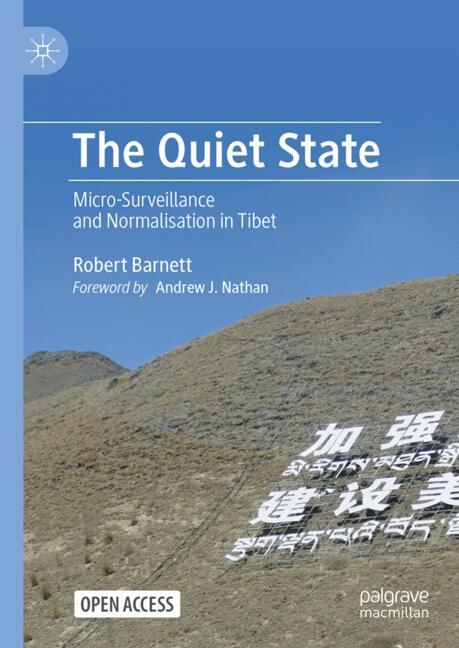
The Quiet State
Springer Nature Singapore·EAN 9789819222698
Qabbel 1 prezz
| Ħanut | Disponibbiltà | Konsenja | Prezz | Action |
|---|---|---|---|---|
 Springer Nature link.springer.com L-aħjar prezz Fl-istokk | Fl-istokk | B'xejn | €53.49 | Mur → Mur fil-ħanut → |
Storja tal-prezz — l-inqas prezz
L-inqas prezz ta' kuljum fil-ħwienet kollha · medja għal dan il-perjodu: €53.49
This open access book is both a meticulously researched account of newly emerging forms of rule in the Chinese borderlands and a broader theoretical intervention into the study of authoritarian governance. Taking the current situation in Tibet as its case study, The Quiet State shows how local officials in Tibet have developed previously unknown methods to micromanage and surveil certain social groups. The book examines one such scheme, involving some ten thousand Tibetan Buddhist nuns who have been singled out for having travelled beyond their home areas to receive religious teachings, resettled in fixed locations, monitored by local officials and residents, and given repeated political education, all under the rubric of state tolerance and care. This exercise in “coercive benevolence” lies at the heart of what the author calls the “quiet mode” of authoritarianism: a post-carceral form of social control, found particularly in ethnic or minority areas, that constrains movement and thought while avoiding the overt use of violence. Presented as routine or “normal” instruments of social management and barely visible even to locals, let alone outsiders, these micro-surveillance schemes are linked to the mass expansion of grassroots governance in Tibet, where for the first time officials are now stationed in almost every monastery and village. Based entirely on the analysis of official Chinese media reports, The Quiet State shows how the study of a few available fragments of information can point to new ways of understanding the contemporary functioning of the state, even in a region where direct research is rarely feasible, and demonstrates the power of open‑source analysis as a rigorous form of remote ethnography. It is an essential guide for researchers in Chinese and Tibetan politics, comparative authoritarianism, surveillance studies, political anthropology and human rights.
Comparano iqabbel il-prezzijiet għal The Quiet State fi 1 ħanut online. L-aħjar prezz llum huwa €53.49. Matul l-aħħar 90 jum, l-inqas prezz ta' kuljum kien medja ta' €53.49. Il-prezzijiet jiġu aġġornati diversi drabi kuljum; il-prezz finali jiġi kkonfermat fil-ħanut.
Aktar minn Springer Nature Singapore

Electronic States in Crystals of Finite Size
Springer Nature Singapore · Kotba
minn €74.89
Ara l-offerta

Progress in Nanoscale Characterization and Manipulation
Springer Nature Singapore · Kotba
minn €171.19
Ara l-offerta

Parity-time Symmetry and Its Applications
Springer Nature Singapore · Kotba
minn €235.39
Ara l-offerta

Quantum Critical Phenomena of Valence Transition
Springer Nature Singapore · Kotba
minn €106.99
Ara l-offerta